Department of Public Works
Section 30 · Pages 203–207 · 0 tables · includes narrative
Department of Public Works
 Department of Public Works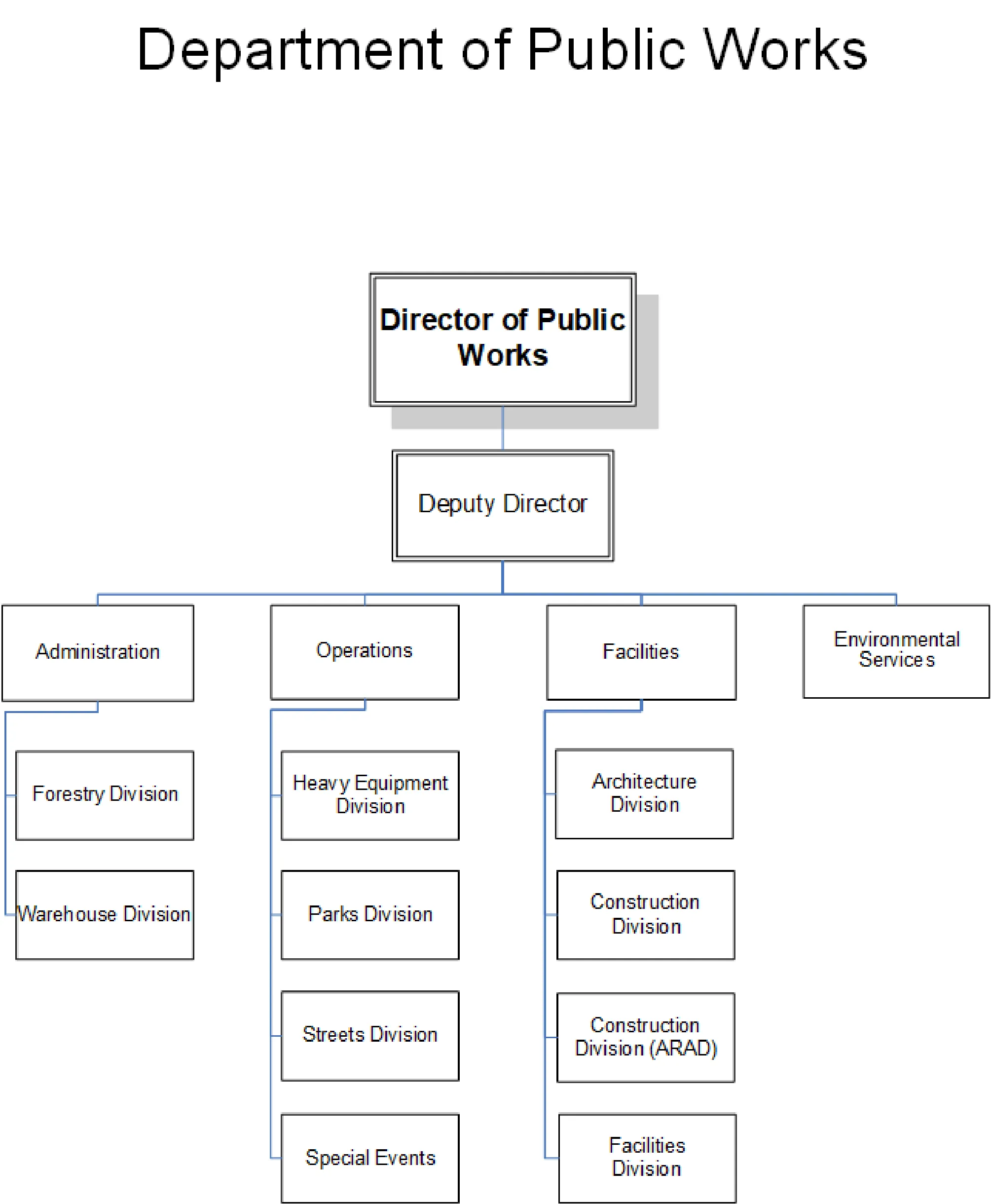
Mission Statement
Maintain the City’s assets related to accessing public streets, parks, facilities, rehabilitating public structures, and maintaining the City's natural environment; provide support to other departments; administer a solid waste and recycling system that promotes a litter-free environment; and ensure public safety responding to weather-related events.
Department/Bureau Overview
The Department of Public Works (DPW) is separated into four (4) bureaus: Administration - The Bureau of Administration is connected to the other three (3) Bureaus in the Department and is divided into three (3) sections and one (1) Division: Fiscal - Responsible for the Bureau’s and Division’s procuring commodities, services, and repairs within budgetary limits. Fiscal also handles all personnel transactions for the department Permits - Responsible for issuing Park Shelter/Field Permits/General Permits ensuring permit holders are in compliance with established rules and regulations and the Pittsburgh Code via the inspection process Warehouse - Responsible for maintaining proper stock levels for commodities and equipment used by departmental divisions, and for the delivery of those assets to various locations Forestry Division - Provides prompt, efficient and safe delivery of Arboricultural services to residents in managing the city’s urban forest consisting of 33,000 street trees and vast acreage of park trees. Functions and duties include:
- Removal of trees
- Pruning
- Root Pruning
- Planting
- Inspection/Investigation
- Permits
- Holiday Tree Installation
- Maintain Computerized Street Tree Database
- Ordinance Enforcement
- Integrated Pest Management (IPM) Operations - The Bureau of Operations is divided into three (3) divisions: Streets Maintenance, Parks Maintenance, and Heavy Equipment. Streets/Park Maintenance - Ensure that all public roadways, streets, bridges, walkways, parks, greenspaces, and recreational areas and facilities are functional, safe, and attractive. Functions and duties include:
- Cleaning, repairing, maintaining, and patching City streets and other public areas
- Removing graffiti and illegal signs from public property
- Ensuring public safety by responding to weather-related events such as flooding, land subsidence, snow and ice storms, and other disasters
- Litter collection
- Emptying trash receptacles
- Turf maintenance
- Landscape maintenance
- Weed control
- Leaf collection and removal
- Snow and ice control
- Field maintenance 205
- Court maintenance including courts for tennis, basketball, hockey, horseshoes, and bocce
- Shelter maintenance
- Play equipment maintenance
- Building maintenance
- Trail maintenance The inventory of public infrastructure maintained by the Streets/Park Maintenance section includes:
- 1,060 lineal miles of streets (890 asphalt, 90 concrete, 80 brick/block stone)
- 2,423 lane miles of streets (2,034 asphalt, 206 concrete, 183 brick/block stone)
- 675 sets of steps covering 23.3 lineal miles
- 2,000 litter receptacles
- 1,672 lots owned by the City that are part of parks, greenways, and City government facilities
- 7,600 lots owned by the City or jointly by the City, County, and Board of Education
- 1,249 additional privately owned vacant lots for which the owner cannot be found (“Dead End” lots)
- 3,647 acres of parkland
- 654 acres of turf
- 160 parks
- 230 courts (basketball, tennis, volleyball, street hockey, horseshoe, bocce, pickleball, and multipurpose)
- 122 fields (ball diamonds and/or rectangular)
- 119 modular playgrounds Heavy Equipment - Responsible for the repair and preventative maintenance of over 1,018 pieces of equipment including but not limited to hilifts/front end loaders, gradalls, skid steers, large area mowers, industrial tractors, plows/spreaders, and a multitude of small landscape equipment (mowers, line trimmers, edgers, blowers, etc.), and the delivery/setup/pickup of large mobile stages and bleachers. Environmental Services - The Bureau of Environmental Services is divided into two (2) divisions, Refuse and Recycling Refuse - The role of this section is to collect regular mixed and bulk solid waste weekly from residential properties, the Housing Authority, the Borough of Wilkinsburg, and City government buildings and to dispose of that solid waste at two (2) landfill locations. Recycling - The City is required by State law to have a recycling program. The role of this section is to maintain, monitor, and advance waste reduction and recycling activities that are fiscally responsible, environmentally-friendly, and compliant with State law for all city residents, businesses, and organizations. Recycling collections are bi-weekly from residential properties with five (5) dwelling units or less, the Housing Authority, Pittsburgh Public Schools, and municipal buildings throughout the city. Private haulers are monitored for compliance with recycling ordinances. Twice a year special compost (yard debris) collections are provided for city residents. An inventory of outputs:
- 115,200 city residential properties serviced weekly
- 7,500 Wilkinsburg properties serviced weekly
- 122 sidewalk recycling bins serviced in Business Districts twice per week
- 88,000 tons of residential refuse landfill
- 15,222 tons of recycling materials collected
- 50,000 tires recycled
- 4,144 tons of yard debris composted
- 17 tons of electronic products collected
- 100 tons of scrap metal recycled
Facilities - The Bureau of Facilities ensures the functional, operational, and aesthetic integrity of the City’s Facility Asset Inventory including its 300 buildings and structures as well as its numerous recreational assets by delivering design, construction, maintenance, and repair services in a timely and proficient manner. The Bureau is divided into three (3) Divisions: Project Management
- Performs quality asset management for facility inventory
- Performs in-house project management and project coordination for all Capital-funded construction projects
- Provides in-house planning and cost-estimation services for construction projects
- Provides in-house design services and design quality review
- Preparation of construction bid documents
- Construction project management
- Outside and agency project liaison and coordination Construction
- Utilizes skilled tradespersons to perform a variety of minor and major renovation projects related to trails, roads, sidewalks, playgrounds, fields, walls, and steps
- Performs infrastructure assessments of assets
- Provides construction cost details and analysis for all in-house construction services Facilities Maintenance
- Utilizes skilled tradespersons to perform a variety of minor renovation and repair projects related to building systems
- Performs building and system condition assessments and preventative maintenance
- Provides construction cost details and analysis for all in-house facilities maintenance and trade services 2025 Accomplishments Bureau of Administration
- Real Time Safety System (RTSS) – Reduced employee injury by 50%, increasing employee morale
- Improved hiring practices with direct collaboration with HRCS
- Increased candidate volume by more direct engagement with managers into the hiring process
- Reduced hiring time and improved candidate communications Bureau of Operations
- Reduced Snow SLA from 36 to 24 hours
- Clean and Liens – increased private properties cleaned annually from 80 (2022) to 400 (2025) annually with no equipment investment Bureau of Environmental Services
- Created a dedicated Environmental Enforcement Team to help tackle blight issues within the City Bureau of Facilities
- Homewood Park completion – Spring 2026
- Medic 4 construction – Summer 2025
- DPW 4th Division – Spring 2026
- 412 Blvd of Allies – Spring 2025
- Creation of Plumbing Shop and Painting Shop
- Creating a Culture of Learning across the Bureau
- Recent process updates between Procurement and the Architecture Division requiring all bidders to produce a Schedule of Values (SOVs) in addition to overall cost, for Architecture review. This change yielded reduced bid costs, identified non-responsible bidders, and kept all bidders accountable to project schedules . 207