Budget Guide
Section 3 · Pages 18–29 · 4 tables · includes narrative
On this page
Budget Guide
 Budget Guide
 Overview of the Government of the City of Pittsburgh The government of the City of Pittsburgh is composed of independently elected and appointed officials who work alongside more than three thousand employees in the service of advancing the interests of City residents. The Mayor and City Controller are elected through a citywide vote. City Council’s nine representatives are elected to office by residents in each of their respective districts. The Office of the City Controller is responsible for auditing all City expenditures, in order to prevent wasteful or fraudulent practices. Additionally, the City Controller reviews and approves contracts and is also charged with reporting to the citizens of Pittsburgh, the Mayor, and City Council the state of the City’s fiscal condition. Every year, the City Controller issues the Annual Comprehensive Financial Report, which provides detailed information on Pittsburgh’s short-term and long-term financial outlook. City Council proposes, deliberates, and votes on legislation governing and/or affecting the City. This body also approves appointments, regulates revenues and expenditures, and approves the final Operating and Capital Budgets. City Council is responsible for the introduction of legislation generated by the administrative branch of City government and may also introduce legislation from individual Council members to the body as a whole. The Office of the City Clerk provides centralized staff support to Council, under the direction of the City Clerk. The City Clerk, with the help of the Records Management Division, serves as a centralized document and information resource to Council, all City Departments, and the residents of the City of Pittsburgh. The City Council Budget Division monitors City finances and conducts independent analyses of City operations. It prepares and distributes periodic reports on revenues, expenditures, and other trends relating to the fiscal condition of the City of Pittsburgh to Council. It supervises and reviews City Council's annual operating and capital budgets and compiles special reports and executive summaries to assist Members in their deliberations. The Office of the Mayor is the largest branch of the government of the City of Pittsburgh and is directly responsible for much of the City’s daily operations. This work is performed by individual Departments, Offices, Bureaus, and Commissions. The services provided by these entities range from public safety and public works to debt management. Many of these departments focus on specific services. For example, the Department of Law acts as a legal advisor to the Mayor, City Council, and other Departments. Two units act as umbrella organizations. The Department of Public Safety Bureau of Administration oversees the Bureaus of Police, Fire, Emergency Medical Services, and Animal Care and Control, as well as the Office of Community Health and Safety. Similarly, the Department of Public Works Bureau of Administration oversees the Bureaus of Operations, Environmental Services, and Facilities. Additionally, there are seven governmental units which fall within the Office of the Mayor in the City’s managerial hierarchy but whose sources of financing exist outside of the City’s General Fund. For this reason, these Authorities are not included in the Operating Budget. A comprehensive visualization of the government of the City of Pittsburgh is included in the organization chart presented in this document.
What is the Operating Budget?
The Operating Budget functions as the financial plan for the current fiscal year. Reported within this document are figures related to planned expenditures and projected revenues for the upcoming fiscal year. Expenditures are spread across all City Departments, Bureaus, and Elected Offices. These expenditures represent costs for the administration and distribution of governmental services. These services include, but are not limited to: public safety, refuse collection, snow removal, street paving, the issuance of permits and licenses, and maintenance and programming for local parks and community recreation centers. In addition, the General Fund also supports the routine administration of local government that includes employee wages and health benefits, workers’ compensation benefits, utility and fuel usage, the funding of municipal pension plans, and debt service. The City collects revenues to finance the costs associated with delivering services to residents. Revenues are collected by the City from the levy of taxes, collection of fees related to the issuance of permits and licenses, charges for services provided by City Departments, fines and forfeitures, intergovernmental revenues, and other revenue generating mechanisms. The Operating Budget combines information relating to expenditures and revenues, creating a plan as to what governmental services can be executed by the City and subsequently delivered to the public within a given fiscal year. The detailed financial figures within this document illustrate both the cost incurred by the City of Pittsburgh in delivering services to the public and the means through which these costs are financed. The Operating Budget also stands as a policy document outlining the strategic initiatives of both the Mayor and Members of City Council. Laws established by the Commonwealth of Pennsylvania restrict how much money the City of Pittsburgh may raise through the levy of taxes and charges for permits and licenses. As a result, the City of Pittsburgh must balance the demands for services against the available resources that it can legally acquire through tax and non-tax revenue generating mechanisms. Given the reality of scarce resources, the City must prioritize initiatives and fund only those determined to be most essential and beneficial to the overall health of the City. The level of funding allocated to individual Departments and programs within the City clearly exhibits priorities set by the City’s elected public officials. Finally, the Operating Budget can be viewed as a legally binding document. All of the costs incurred by the City of Pittsburgh in providing day-to-day public services must be paid for out of the Operating Budget. Therefore, the City of Pittsburgh must act within the confines of the financial details outlined within this document. The Operating Budget can only be altered through a series of formal processes, which parallel those enacted in the initial creation of the plan.
Basis of Accounting
The General Fund budget is adopted on a cash basis of accounting, meaning that the City of Pittsburgh recognizes revenues when they are received and expenditures when they are paid.
The Fiscal Year
The City of Pittsburgh’s fiscal year begins on the first day of January and ends on the last day of December of each year. {er the Home Rule Charter, this could be changed by ordinance.
Balanced Budget Mandate
The City’s Home Rule Charter requires that the annual Operating Budget be balanced, with estimated revenues equal to or greater than estimated expenditures. Should revenues exceed expenditures at the end of a fiscal year, the budget surplus is transferred into the City’s reserve fund balance.
The City’s Fund Structure
In accordance with generally accepted accounting principles, the City’s financial reporting system is organized on a fund basis consisting of two major types of funds: governmental and fiduciary.
The General Fund is the main operating fund for the City. It includes most tax revenues and is used to sustain most of the City’s day-to-day activities, including public safety, public works, parks, planning, and general administration. The Capital Projects Fund is used to fund construction and/or maintenance of any public property, facility, or program (such as buildings, park facilities, infrastructure, information technology systems) that is expected to provide a long-term benefit to the City. All capital projects must meet two requirements: a minimum value of $50,000 and a life expectancy greater than five years. Funding for the Capital Projects Fund comes from three major sources: Pay-As-You-Go (PAYGO) funding, bonds, and State and Federal Funds. Projects funded by bond should have a minimum useful life no shorter than the length of the issuance. For more detail on the Capital Budget and what it funds, please refer to the 2026 Capital Budget document. Community Development Funds are funded primarily by the federal Department of Housing and Urban Development (HUD). These funds are earmarked for projects relating to housing, economic development, and human services needs in neighborhoods with a high concentration of low- to moderate-income households. Special Revenue Funds are funds in which a substantial portion of the proceeds or inflows are restricted or committed for a specific purpose. Examples of these include the Liquid Fuels Fund, the Pittsburgh Partnership Fund, and the Grants Fund. While they are included in this document, the City only sets formal appropriations for two of the funds: the Stop the Violence Fund, and the Parks Tax Fund. Although many of these include the word “trust” in their titles, this is more of an informal recognition that the funds are designated for special purposes; the funds are not held by any trustees or custodians. Fiduciary Funds are used to account for resources held for the benefit of parties outside the government. These resources are not available to support the City of Pittsburgh’s own operations and are custodial in nature. The City’s pension plans and its agency funds fall under this type of fund.
- The City administers three pensions for full time employees: one for police officers, a second for firefighters, and a third for municipal employees.
- Agency funds include accounts held for employee benefits, payroll withholding, escheats, and tax refunds. The Workers Compensation VEBA (Voluntary Employee Beneficiary Account), the OPEB (Other Post-Employment Benefits) Trust Fund, and Real Estate Tax Refunds Trust Funds are examples of Fiduciary Funds. Budget Allocations This budget document divides total expenditures across the Elected Offices, Departments, and Bureaus that comprise the government of the City. Individual divisions carry out unique tasks.
Budget data table.
| Governmental Funds |
|---|
| General Fund Capital Projects Fund Community Development Funds Special Revenues Funds |
| Fiduciary Funds |
| Pension Trust Fund Agency Funds |
The City utilizes a hierarchical chart of accounts to distribute funds to each Department, Bureau, Agency, and Elected Office. These accounts are organized by levels of detail, with the individual object accounts being the most specific: Fund ... Cost Center ... Subclass ... Object Account The legal appropriations in the Operating Budget refer to the General Fund, which is coded as 11101. Costs are next delineated by distributing funds across the City’s divisions, referred to here as cost centers. City Offices, Departments, and Bureaus (Cost Centers) 106000 Office of the City Controller 101100 City Council Districts 101200 Office of the City Clerk 102000 Office of the Mayor 102200 Office of Management and Budget 103000 Department of Innovation and Performance 105000 Commission on Human Relations 107000 Department of Finance 108000 Department of Law 108100 Ethics Hearing Board 240000 Office of Municipal Investigations 109000 Department of Human Resources and Civil Service 110000 Department of City Planning 130000 Department of Permits, Licenses, and Inspections 210000 Department of Public Safety – Bureau of Administration 220000 Bureau of Emergency Medical Services 230000 Bureau of Police 250000 Bureau of Fire 280000 Bureau of Animal Care and Control 102300 Office of Community Health and Safety 410000 Department of Public Works – Bureau of Administration 420000 Bureau of Operations 430000 Bureau of Environmental Services 450000 Bureau of Facilities 500000 Department of Parks and Recreation 600000 Department of Mobility and Infrastructure 999900 Citizen Police Review Board Costs are next directly assigned to a subclass, which is a general expenditures category. These include personnel costs and costs incurred as a result of general operations.
Subclasses
51 Personnel - Salaries and Wages
52 Personnel - Employment Benefits
53 Professional and Technical Services 54 Property Services 55 Other Services 56 Supplies 57 Property 58 Miscellaneous 82 Debt Service 90 Transfers 91 Transfers - Out
The chart of accounts delineates these subclasses into further detail called object accounts. Object accounts are the most detailed level to which the City of Pittsburgh budgets. Expenditures are both budgeted and recorded using the account string depicted below. The account string begins by identifying the fund, followed by the cost center (City division), subclass (expenditure category), object account (expenditure category detail), and fiscal year. Below is an example account string that represents expenditures related to postage for the Department of Finance. 11101.107000.56.56105.2026 11101 107000 56 56105 2026 General Dept. of Supplies Postage Fiscal Fund Finance Year What Are the City's Sources of Revenues? Annual City of Pittsburgh revenue is generated by both tax and non-tax sources. There are seven subclasses.
Tax Revenue
Taxes comprise the majority of City of Pittsburgh revenues. In addition to wage and property taxes, there are many that are generated by the wide range of services, institutions, and entertainment available within the City. They are collected from both residents of the City of Pittsburgh as well as nonresidents, when appropriate. The Earned Income Tax is a conventional 3 percent wage tax applied to City and School District residents who earn wages, salaries, tips, bonuses, or other net profits in a given year. City residents pay a 1 percent City tax and a 2 percent School District tax. Interest, dividends, active duty pay from the Armed Forces, pensions, social security, and capital gains are commonly excluded. The City collects Real Estate Taxes on behalf of the City, the School District, and the Carnegie Library of Pittsburgh. Real estate taxes are levied on land and buildings located within the City of Pittsburgh. Assessments are conducted at the county level by the Allegheny County Office of Property Assessments and the tax is collected based on the fair market value of property. he City real estate tax rate is 9.67 mills (as of 1/1/2026), the School District real estate tax rate is 10.46 mills (as of 1/1/2026), and the Carnegie Library real estate tax rate is 0.25 mills. Tax relief is provided through various programs including the Homestead Exemption (Allegheny County Act 50 of 1998) and Senior Tax Relief (Allegheny County Act 77 of 2000). The Payroll Preparation Tax is levied at the rate of 0.55 percent on the gross payroll of employers and the distribution of net income from self-employed individuals, members of partnerships, associations, joint ventures or other entities who perform work or provide services within the City of Pittsburgh. Nonprofit and other charitable organizations are excluded from this tax. The Parking Tax is collected from users of private and public parking facilities located within the City of Pittsburgh. A portion of the Parking Tax is dedicated to the City of Pittsburgh’s pension fund until 2051.
Shows projected revenue by source.
| Revenues |
|---|
| 41 Tax Revenue 42 License and Permit Revenue 43 Charges for Services 44 Fines and Forfeitures 45 Intergovernmental Revenue 46 Interest Earnings 47 Miscellaneous Revenues |
Other sources of tax revenue for the City of Pittsburgh are the Local Service Tax, the Amusement Tax, the Deed Transfer Tax, the Public Service Privilege Tax, and the Institution and Service Privilege Tax. In 2024, actual tax revenue totaled $528,372,340, or 75.1 percent of total City revenue. City of Pittsburgh voters approved a referendum in 2019 to add 0.50 mills to the real estate tax to collect funds for the improvement of the City's parks. These funds are not deposited into the General Fund. Please see the Parks Tax Trust Fund section for more information.
Non-tax Revenue
“Non-tax revenue” is a catch-all term referring to funding mechanisms utilized by the City of Pittsburgh that do not directly involve the levying of taxes. Residents may be familiar with examples such as building construction permits and liquor and malt beverage licenses. However, there are other types of non-tax revenue, such as interest earnings on investments, that are less visible. Generally, the two largest subclasses of non-tax revenue for the City of Pittsburgh come from intergovernmental sources and license and permit fees. Each year, the City of Pittsburgh receives funding from federal, state, and local government sources in the form of grants, aid, and reimbursements for services performed. For example, the Liquid Fuels Tax object account consists of funds received from the state and offsets some of the costs of road maintenance and road salt. Most intergovernmental funding comes from the Commonwealth of Pennsylvania in the form of pension aid. Local entities, such as the Pittsburgh Parking Authority and the Pittsburgh Water, and federal agencies also contribute to intergovernmental revenue. In utilizing this funding, the City's goal is to enhance the quality of municipal services and reduce the City's financial burden. Many City departments provide various services for which rent or fees are charged. Examples of these fees include payments for safety inspections, copying City documents, rents from City properties, and the use or sale of rights of way. In addition, the City is compensated for services provided to other municipalities and governmental entities. For example, Emergency Medical Services collects fees after it transports individuals to receive medical care. In 2024, actual non-tax revenue totaled $174,954,796, or 24.9 percent of total City revenue.
How Does the City Spend Money?
The tax and non-tax revenue collected annually by the City of Pittsburgh is used to provide services to residents ranging from refuse pick-up to the regular maintenance of capital assets. Expenditures are monitored by department or division and by subclass. Major expenditures include health insurance costs, pension payments, and workers’ compensation claims for City of Pittsburgh employees. The Operating Budget also pays the principal and interest costs associated with past and current issuance of debt generated by previous and ongoing capital projects and other programs. The chart below illustrates historic costs associated with debt service, pension and other post-employment benefits (OPEB) contributions, health insurance and workers’ compensation.
Select Major Expenditures, 2020-2024 150,000,000
100,000,000
)snoilliM( $ 50,000,000
0
ce io n OPEB Debt Service a n a t s u r ns n and h I n mpe Healt ' C o io s n s k e r P e W o r 2020 2021 2022 2023 2024
Health Insurance
These expenditures are categorized within the Personnel – Employment Benefits subclass. Prior to 2016 these expenditures were budgeted centrally in the Department of Human Resources and Civil Service. Except for retiree health insurance, these expenditures are budgeted across all divisions based on staffing levels and plan elections.
Budget data table.
| Health Insurance |
|---|
| 52101 Health Insurance 52111 Other Insurance and Benefits 52121 Retiree Health Insurance |
Budget data table.
| Workers' Compensation |
|---|
| 52301 Medical - Workers' Compensation 52305 Indemnity - Workers' Compensation 52309 Legal - Workers' Compensation 52314 Workers' Compensation Settlement 52315 Workers' Compensation Fees |
Workers’ Compensation
These expenditures are categorized within the Personnel – Employment Benefits subclass. Most medical, indemnity, and fees are budgeted across divisions with outstanding claims. Legal and settlement expenses remain budgeted in the Department of Human Resources and Civil Service with accounts organized as follows:
Pension & OPEB
The City of Pittsburgh operates three pension plans for retired police, fire, and municipal employees. "Other post- employment benefits" refers to benefits, such as health insurance, that are provided to qualifying retired City workers. These expenditures are housed within the Personnel – Employment Benefits subclass in the Department of Finance and are organized via the following individual accounts: 25
Pension and OPEB
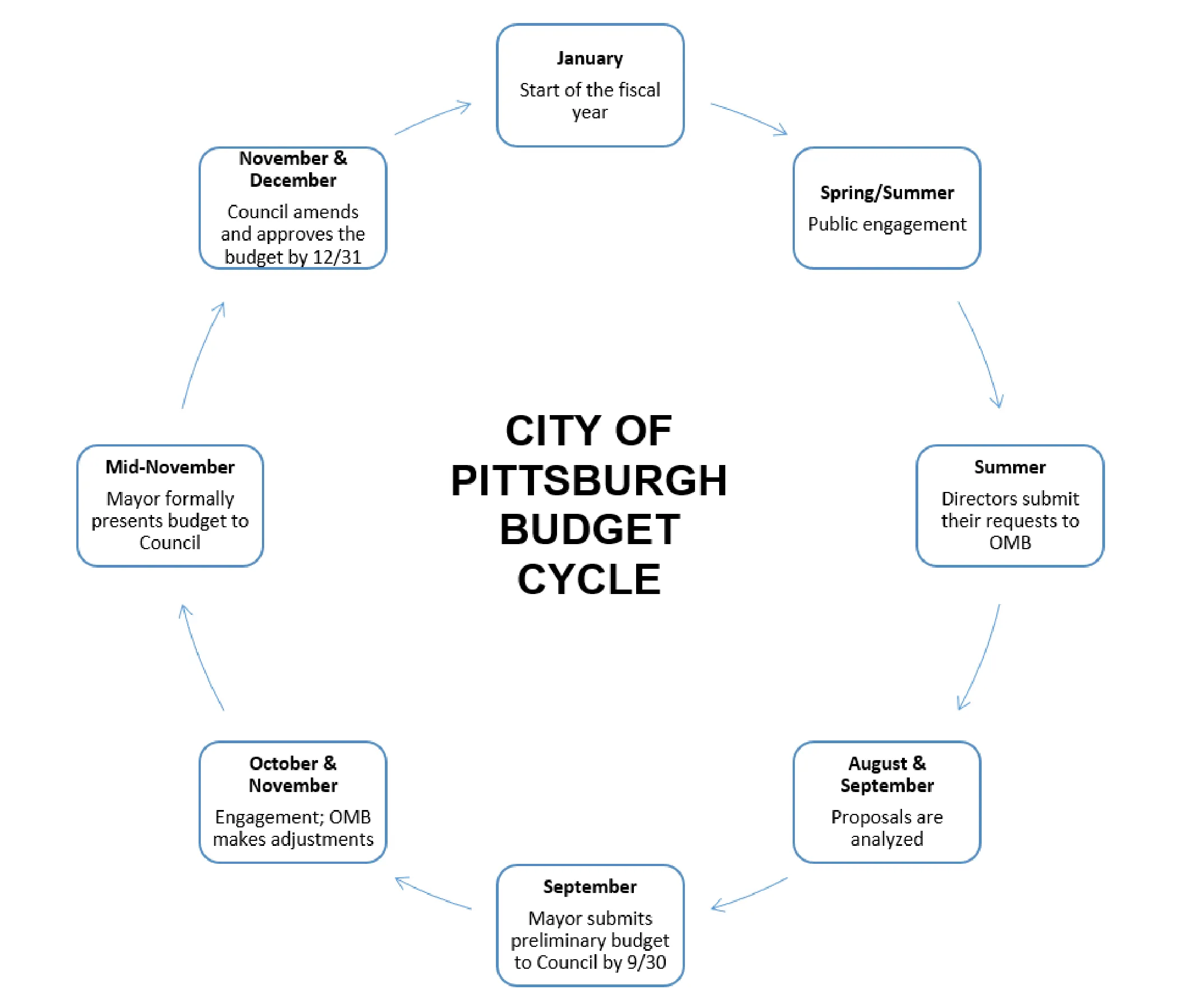
52401 Pension Contribution 52404 Retiree Contribution 52407 Widow(er) Contribution 52410 Survivor Contribution 52413 Additional Pension Fund 52416 Early Retirement Healthcare 52419 Retired Police Officer 52422 Retired Firefighters 52423 Retired EMS 52605 Retirement Severance 52901 OPEB Contribution Debt Service Debt service is defined as payments made to the principal and interest balances of previously issued municipal bonds in order to ensure their timely retirement. Debt service exists as its own subclass within the Department of Finance and is composed of the following accounts: Debt Service 82101 Interest Expense - Bonds 82103 Principal Budget Creation Process The operating budget development cycle begins in late spring, when the Office of Management and Budget (OMB) forwards a memorandum detailing the budget preparation process and general high level expectations, policy goals, and citywide strategic initiatives to all City divisions. OMB also holds public meetings, as required by City Code. After receiving baseline budgets from OMB, individual divisions work with their budget analysts to draft and submit proposals. Each division presents budget proposals to OMB. These proposals include current year achievements, requests for general and project-specific funding, and personnel position changes. The Mayor reviews the proposals to ensure that requests align with citywide goals and strategic plans/initiatives and decides which, if any, should be funded. The Mayor releases a preliminary budget at the end of September. OMB solicits additional public feedback. If fiscal conditions allow for changes, revisions are made. When the proposals and the Mayor’s strategic initiatives are aligned, the Mayor formally submits both budgets to City Council in November. City Council reviews the budget and holds a number of meetings and televised hearings with each division. After consideration of public input and Member priorities, City Council makes changes to the budget and then holds a vote to adopt the budget. This must occur before December 31st. Failure to enact a budget prior to January 1st of the new year means that the City cannot pay any vendors, cannot undertake any projects, and cannot (subject to collective bargaining agreements) pay any employees. The last time a budget was not approved before December 31st was 1931. Upon adoption, OMB is responsible for implementing and overseeing the City of Pittsburgh’s Operating and Capital Budgets. Throughout the fiscal year, OMB monitors the City’s expenditures and revenues, provides legislative oversight on any matters related to the budget, and oversees budget transfers and adjustments. Analysts in OMB prepare quarterly reports on the performance of major revenue sources and expenditure categories, reports on key factors driving the budget, reports on cash flow, and brief updates on important management initiatives. 26
Five-Year Financial Forecast
In addition to developing the budget, OMB and the Department of Finance are responsible for estimating both expenditures and revenues for the four years following the next fiscal year. Together, these estimates comprise the five-year financial forecast reported in the budget document. The five-year forecast allows City Officials to evaluate the fiscal health of the City for a longer period of time. This aids in identifying any future trends related to revenues and/or expenditures that may have an immediate or long- term impact on City operations. In addition, the five-year plan is used by City decision makers when planning for long-term strategies, formulating departmental and citywide initiatives, and developing new policies that might result in a financial impact. The financial forecast is an essential tool in maintaining financial discipline, thus ensuring the delivery of essential services to residents of the City of Pittsburgh.
Revenue Forecast
Revenues represent the available resources afforded to the City to carry out basic administrative operations and deliver services to City residents. The ability of the City of Pittsburgh to generate revenue is governed by the rights afforded to the City under its Home Rule Charter and by the laws of the Commonwealth of Pennsylvania. Projected future year expenditures are directly influenced by future year revenues projections. The Department of Finance utilizes a variety of techniques and information sources to develop revenue forecasts. Previous years’ financial data is used to forecast growth for major tax and non-tax revenues. Monthly and end-of- year financial data related to all revenues are archived and updated in the City’s enterprise resource planning (ERP) system. This information is then analyzed through statistical methods to ascertain growth in each revenue line. Where applicable, the City then applies a growth rate to each revenue line. In addition to the previous years’ financial data, the City consults with S&P Global to forecast regional economic variables. These economic variables help to inform how various aspects of the economy can affect revenue generating activity in the City. The City also incorporates data from federal government agencies such as the Bureau of Economic Analysis and the Bureau of Labor Statistics and organizations such as Fannie Mae, the National Association of Realtors, and RealSTATs. Revenue projections are finalized after a series of meetings with various stakeholders related to the City of Pittsburgh’s Operating Budget. The City Controller verifies that budgetary assumptions and estimates are developed in accordance with generally accepted auditing standards and that revenue assumptions are reasonable. Following consensus by all stakeholders in the budget development process, the revenue projections are finalized and incorporated into the five-year financial forecast.
Expenditure Forecast
OMB is responsible for developing the expenditure projections for the five-year forecast. To develop these forecasts OMB first enters all known future year expenditures into its budget management software. These known expenditures are those that are either contractual (professional service contracts, debt service payments, pension contributions, etc.) or generally predictable (staffing levels in each department, citywide salary increases, etc.). OMB then develops forecasts which consider past year expenditure data and future growth, strategies, and initiatives. While most costs remain relatively static some expenditures lines, such as healthcare and fuel, are subject to growth in future years. These increases are largely a product of costs rising in the private market. This is accounted for in the financial forecast by applying a percentage growth each year based on trend, Lastly, the Directors of each City division present any requests that are not captured by the methods described above. These requests are often related to software, equipment, or personnel and are regarded to be essential in achieving the goals or augmenting the services of each individual Department. OMB compiles all such requests and evaluates how they relate to the Mayor’s strategic initiatives. Subject to available funds, those requests that fall in line with the citywide initiatives are funded in each respective division’s budget in the five-year forecast. 27
How to Read the Budget
Throughout this budget document, financial data is illustrated in a variety of ways. In general, each separate section of the document reports the same financial data. The level of detail is the only substantial difference between each report within a section.
Departmental Sections
The most detailed and specific illustration of the General Fund Operating Budget financial data can be found in the Departmental Sections of the document. This section details funds by subclass and account that have been appropriated to each individual division. The following are the different components that in aggregate make up the Departmental Sections of the Operating Budget.
Organization Chart
The organization chart is a visual depiction of the functional areas within each City Department, Agency, Bureau, or Elected Office that are responsible for the execution of services and programs. The chart is very general; with the exception of directors or other managers, the chart does not identify individual positions.
Departmental Overview
At the beginning of each departmental section, readers will find a Mission Statement which defines the organization. The Mission Statement is followed by an overview that provides a detailed description of the department. This section of the narrative describes different functional areas within each Department, Agency, Bureau, or Elected Office and their associated services or programs. Current year accomplishments are listed.
Position Summary
The position summary lists all of the budgeted jobs within the organization. The full-time equivalent, or “FTE,” represents the number of full-time workers in the position. The “Rate/Grade” category indicates how an employee’s pay level is calculated. Grade and step plans for non-union employees and AFSCME 2719 employees can be found as an appendix to this document. For full time positions, a “12” in the “Hours/Months” column indicates that the position is budgeted for all 12 months in the year. Smaller numbers indicate a position starting or ending mid-year. For part time positions, the number in this column represents budgeted hours of work. The “Budget” column highlights the total amount, in dollars, that is allocated to pay all personnel in that position. The “Vacancy Allowance” adjusts the subclass expenditures to account for savings associated with vacant positions throughout the year. A summary from 2025 is also included to facilitate comparisons.
Subclass Detail
This portion of the departmental budget includes 2024 actual expenditures and budget numbers at the subclass and object account level. For example, the general “Professional and Technical Services” subclass will highlight the appropriation amounts for specific accounts, such as “Administrative Fees,” “Workforce Training,” and “Computer Maintenance.” Readers can easily compare budgeted expenditures from 2025 with budgeted expenditures for 2026. The final columns shows the difference and percent difference between the 2025 and 2026 budgeted amounts.
Under the Personnel – Salaries & Wages subclass, there are several important details. Regular salary represents the total full-time base pay for the organization while Part-Time numbers represent employees who work less than 2,080 hours per year. This includes temporary and seasonal workers and interns. Longevity pay is awarded to employees in certain collective bargaining agreements based on seniority and tenure. Salary allowances cover payments for work that meets certain criteria, like hazardous material response. When uniform allowances are paid directly to employees, their costs are listed accordingly. Leave Buyback represents sick leave hours that can be “sold back” to the City. Premium Pay appropriations compensate for overtime hours.
Five-Year Forecasts
Finally, the five-year forecast allows readers to consider what the City expects to spend in the future. In addition to the 2026 budget, there are projections for 2027 through 2030. The percent change from the prior year is included as a reference point.
Note for Fund Accounts
For special revenue accounts that are included in the Operating Budget, the Fiscal Year 2026 summary is composed of the “Projected Beginning Balance” for January 1, 2026, anticipated revenues and expenditures, and the “Projected Ending Balance” for December 31, 2026. These funds carry over from year to year. A position summary follows when appropriate.