Office of Community Health and Safety
Section 29 · Pages 197–202 · 2 tables · includes narrative
Key changes
- Budget decreases 0.0% ($0)
On this page
Office of Community Health and Safety
 Office of Community Health and Safety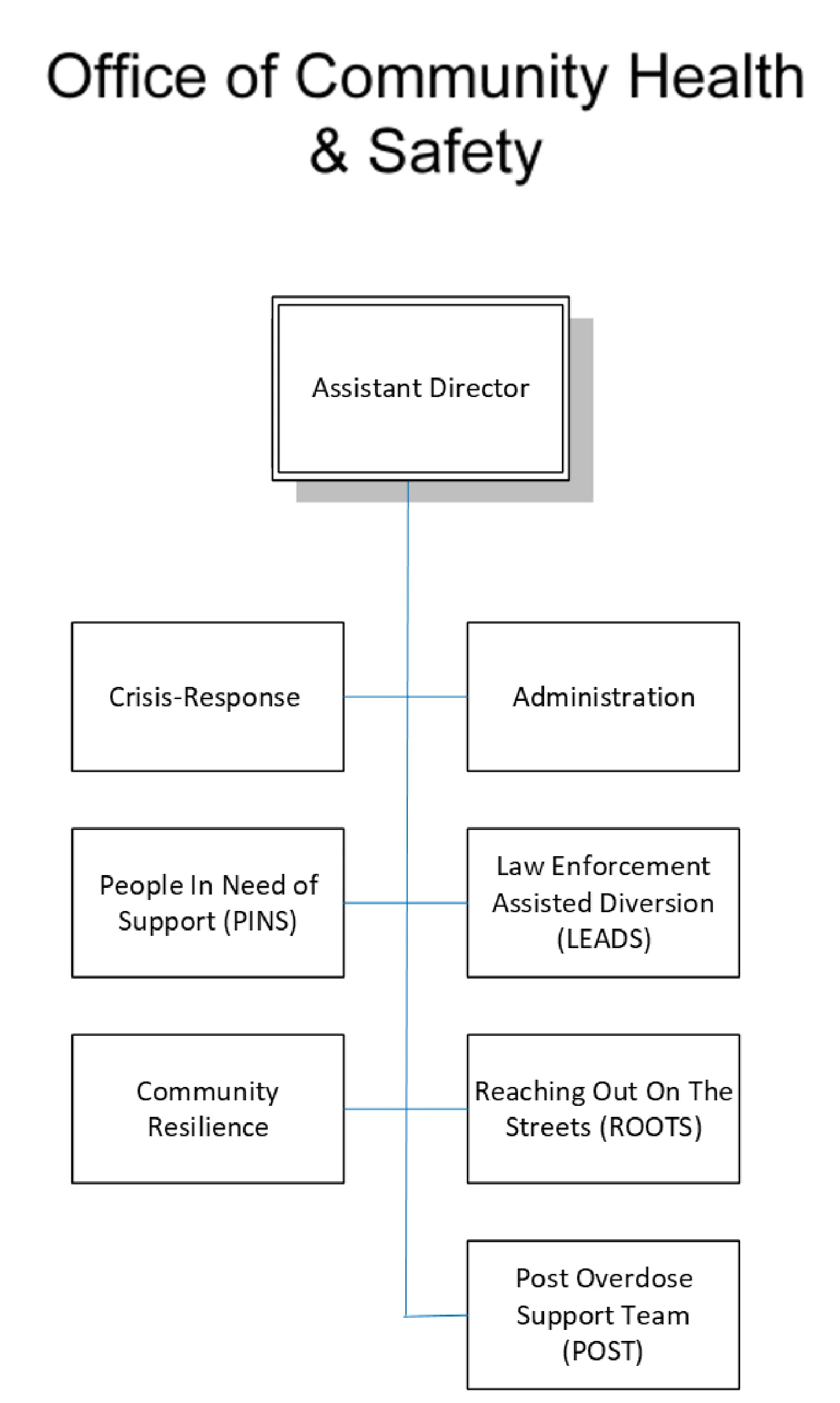
Mission
The City of Pittsburgh created the Office of Community Health and Safety to connect our most vulnerable neighbors with the right services to make our city safer and more just. Our mission is to serve marginalized communities that have been systematically isolated from society and victimized by an unjust system. Through the tireless work of our frontline workers, public safety liaisons, and subject matter experts we aim to address the needs of those living in poverty, experiencing homelessness or housing instability, substance use disorder, and mental or behavioral health challenges.
Departmental/Bureau Overview
The Office of Community Health and Safety is focused on building a response continuum and developing sustainable upstream interventions to address unmet community social service needs that often fall to Public Safety personnel, who represent the 24/7 safety net response. Through partnerships and program development, the Office will focus on: Community Resilience: The Community Resilience program is a community-focused program that strives to promote shared ownership, ensure solutions are culturally responsive, and community driven. It seeks to proactively address the root cause of inequities and engage with residents and leaders to identify challenges, build trust, and utilize community needs assessments to co-create strategies that promote safety and inclusion. Critical to meeting these goals are partnerships with registered community organizations, service providers, and other community resources. In addition to proactive outreach efforts, the program also prioritizes responsiveness to community needs such as those that relate to trauma, providing crucial immediate support and connection to higher levels of care to residents after traumatic events occur to begin the process of healing. Law Enforcement Assisted Diversion Program: Law Enforcement Assisted Diversion (LEAD) is an effective, replicable, and equitable diversion method that provides individuals with intense case management. It is a client- based approach that provides people with substance use disorder and mental and behavioral health challenges, experiencing homelessness and poverty with person-centered social services and intense case management focused on harm reduction and compassion in lieu of criminalization. The goal of LEAD is to break with traditional methods rooted in coercion and punishment to address the needs of individuals experiencing poverty, homelessness, substance use disorder, and mental and behavioral health challenges. LEAD combats racial and ethnic disparities within the criminal-legal system that have been perpetuated by harmful systems, stigmatization and lack of access to services. The initiative ignites a pathway towards criminal justice reform specifically to end harmful policing and criminalization of minorities and vulnerable populations. Reaching Out On the Streets: The Reaching Out on the Streets (ROOTS) Program aims to reduce the prevalence of homelessness by addressing the social determinants of health, opening opportunities for personal agency, and intervening in critical moments of crisis to reduce criminal legal interactions, increase access to services, and reduce fatal overdoses. ROOTS will incorporate two components at full implementation: street outreach and drop-in sites. The staffing plan and organization align to support these programs. Interdisciplinary Zone Teams will meet the needs of individuals within the hyper-local scope of available services. Interdisciplinary Zone Teams include members from street outreach, sites, and diversion programs that coordinate participant care and are adaptable to complex needs; such as, human services, drug and alcohol treatment, housing, healthcare, behavioral health, and criminal legal navigation. Post Overdose Support Team: The Post Overdose Support Team (POST) responds to overdoses with teams of certified peer recovery specialists (CPRSs) and case managers to reach individuals at the time of interception with public safety personnel. The response aims to enable the POST team to foster a connection that places the individual in a deescalated state following the overdose, allowing us to begin the work of providing service connections that can lead to long-term recovery. Many people who have overdosed refuse transport to the hospital by EMS. This affords the POST team its opportunity. Trust-building that follows de-escalation is an integral initial step in order to facilitate the willingness of the individual to continue to engage POST staff after EMS has departed to ensure that the provision of service connections and system navigation may continue. The 199
responding team and follow-up case management staff identifies its primary goals to support safety, recovery, and to provide service connections that aim to treat substance use and/or co-occurring mental health disorders. Crisis Response: The Crisis Response program is developed to provide the “right responders” to individuals who are experiencing a mental health or behavioral crisis. Teams consist of a Community Social Worker and dedicated officer who are dispatched to co-respond to individuals in crisis. Through trust-building and the provision of services, Crisis Response seeks to reduce the propensity for individuals who experience mental and behavioral health crises to engage in violent behavior and become involved in the criminal justice system. Through the reduction in use of force, the program also aims to increase both the officer and community member’s safety. This will be supported by training Crisis Response Officers on Crisis Response Intervention Training (CRIT), a national best-practice model rolled out by the Department of Justice. People In Need of Support: The PINS program developed as a partnership between the three Public Safety Bureaus and the Office of Community Health & Safety. First responders identify and refer City residents who frequently utilize 9-1-1 services to meet their basic needs, as well as individuals who may be vulnerable to harm and need follow up. Community Social Workers and Public Safety liaisons conduct home visits to assess the health and social needs of these residents and develop a plan to link the residents to services and resources (including CIT and FBI cases). High utilizers also known as "frequent flyers" who disproportionately utilize 9-1-1 services place strain upon the emergency response system. By connecting these individuals to long-term services and supports, we relieve pressure on the systems in place to assist people who experience crises. Nationally, these programs are known to provide systems-level cost-savings. Note: The Office of Community Health full time positions can be found in the Stop the Violence trust fund.
2025 Accomplishments
- The Office of Community Health & Safety has reached 9,510 encounters as of September 2025 and 1,785 unique participants served, demonstrating the scale of impact and involvement with City of Pittsburgh communities. The top three reasons for referrals to OCHS programs were need for mental health services, housing assistance, and addressing high utilization of 911. Behind this data are hardworking OCHS staff who provided daily critical support and connection to our most vulnerable residents.
- ROOTS led efforts to address public health hazards, including propane tanks, abandoned encampment sites, and syringe waste in collaboration with POST, DPW, and Allegheny Cleanways, resulting in the removal of thousands of pounds of waste from city streets.
- Community Engagement conducted 4 mental health de-escalation and Narcan trainings across the City of Pittsburgh, with a projection to complete 10 trainings by year’s end, and expanded harm reduction outreach efforts, distributing Narcan kits, fentanyl test strips, and educational resources at community events and neighborhood gatherings.
- Piloted an initiative to provide crime scene clean-up services to support families impacted by homicide or suicide, reducing trauma exposure and aiding in recovery.
- Maintained weekly after-school drop-in hours at Phillips and Ammon Recreation Centers, providing a safe space and consistent support for at-risk youth, fostering positive relationships, and reducing risk behaviors.
- Collaborated with law enforcement and court partners to design a Behavioral Assessment Unit evaluation request form for officers to use upon arrest. This tool improves continuity of care by ensuring timely evaluation and treatment for individuals with SPMI while incarcerated and after release.
- Received $1.875 million grant from the Pennsylvania Department of Drug and Alcohol Programs to pilot the City of Pittsburgh’s first ever diversion drop-in center.
Subclass Detail
Compares actual, budgeted, and proposed spending across fiscal years.
| 2024 Actual | 2025 Budget | 2026 Budget | Increase/ (Decrease) | % Change | |
|---|---|---|---|---|---|
| Expenditures | |||||
| 53 - PROFESSIONAL & TECHNICAL SERVICES | 807,096 | 36,000 | 36,000 | — | —% |
| 53301 - Workforce Training | 5,395 | 6,000 | 6,000 | — | |
| 53509 - Computer Maintenance | 49,929 | — | — | — | |
| 53901 - Professional Services | 751,772 | 30,000 | 30,000 | — | |
| 56 - SUPPLIES | 18,720 | 22,000 | 22,000 | — | —% |
| 56101 - Office Supplies | 682 | 1,000 | 1,000 | — | |
| 56151 - Operational Supplies | 18,038 | 21,000 | 21,000 | — | |
| Expenditures Total | 829,217 | 58,000 | 58,000 | — | —% |
Five Year Forecast
OFFICE OF COMMUNITY HEALTH AND SAFETY 2026 Expenditures by Subclass
56 - SUPPLIES
53 - PROF. & TECHNICAL SERVICES
Projects budget figures across multiple future years.
| 2026 | 2027 | 2028 | 2029 | 2030 | |
|---|---|---|---|---|---|
| Expenditures | |||||
| 53 - PROF. & TECHNICAL SERVICES | 36,000 | 36,000 | 36,000 | 36,000 | 36,000 |
| 56 - SUPPLIES | 22,000 | 22,000 | 22,000 | 22,000 | 22,000 |
| Total | 58,000 | 58,000 | 58,000 | 58,000 | 58,000 |
| % Change from Prior Year | —% | —% | —% | —% | —% |