Capital Budget Introduction
Pages 1–26 in Capital Budget · 8tables · includes narrative
2027 Mayor's Capital Budget And Six Year Plan November 9, 2026
 Capital Budget Introduction
TTHHEE CCIITTYY OOFF PPIITTTTSSBBUURRGGHH
CCOORREEYY OO’’CCOONNNNOORR MMAAYYOORR OOFF PPIITTTTSSBBUURRGGHH
Rea Price, Director, Office of Management and Budget
Dan Gilman, Chief of Staff
Jennifer Gula, Director of Finance
Elizabeth Cercone, Assistant Director - Operating and Special Revenue Avery Hart, Senior Budget Analyst Alex Wagner, Budget Analyst Eric Shultz, Budget Analyst Jackson Neofes, Budget Analyst
David Hutchinson, Assistant Director - Capital and Asset Management Brendan Coticchia, Manager, Capital Budget Irving Hu, Budget Analyst
Laurie Loper, Budget Technician
Special thanks to Avery Hart for cover design and photo and to Giovanni Svevo for project maps
Introduction
The 2027 Capital Budget and Capital Improvement Plan
This document is the 2027 Capital Budget and Capital Improvement Plan (CIP) as introduced by the Mayor. It contains a list of capital projects, along with funding levels for each of these projects. WHAT IS A CAPITAL PROJECT? Title II, Chapter 218 of the City Code defines a capital project as: “Any project funded by public monies to design, build, restore, retain, or purchase any City-owned or maintained asset that is expected to provide a long-term public benefit or propose physical improvements in an element of the City’s infrastructure. Capital Projects shall have a minimum value of fifty thousand dollars ($50,000) and a minimum useful life of five years. Capital Projects financed through debt should have a minimum useful life no shorter than the length of debt service. Capital Projects that have a shorter minimum useful life should be funded with PAYGO funds.” While maintenance is not a capital expenditure, capital projects do include renovation and major repair or reconstruction of damaged and deteriorating City-owned or maintained assets. SOURCE OF FUNDS PAYGO: The City funds a number of capital projects through a transfer from the General Fund into the Capital Projects Fund. PAYGO (or “pay-as-you-go”) transfers are funds that the City spends on capital projects that may not be eligible for bond or CDBG funds. In the 2027 Capital Improvement Plan, projects funded with PAYGO focus on the remediation of dangerous and condemned structures, pedestrian safety improvements, and expansion of the City’s vehicle fleet. Bond: Because capital projects have a useful life extending beyond a few years, the City may incur debt in the form of municipal bonds in order to complete capital projects. The City incurs debt for two reasons. The first is that debt is an instrument to spread the cost of a project over all of the citizens who will benefit from the project: not just current citizens, but future ones as well. The second is the City does not have the funds on hand to complete the majority of projects from its own sources. Therefore, projects funded with debt proceeds should be long-lasting because we will be paying for the life of the debt. CDBG: The City receives support for capital projects from the federal government in the form of the Community Development Block Grant (known as “CDBG”). As a block grant, the program gives the City some flexibility on how to spend the money, provided the projects funded benefit low- and moderate- income people, benefit seniors, eliminate blight, or address a threat to health or safety. OTHER: The City uses numerous other sources to pay for capital projects. The federal government, the Commonwealth of Pennsylvania, or other governmental authorities fully or partially fund projects through grants. Foundations and non-profits support through donations or other contributions. The state and federal government typically reimburse a portion of the cost of large transportation improvement projects on the regional Transportation Improvement Plan (also known as “TIP”). The
2027 Capital Improvement Plan also includes funding from the Parks Trust Fund approved by voters in November 2019.
2027 Capital Budget by Fund Source
CDBG$12,500,000
OTHER$57,564,797
BOND$66,500,000
PAYGO$8,700,000
Total: $145,264,797 THE CAPITAL BUDGET PROCESS The capital budgeting process begins with the first meeting of the Capital Program Facilitation Committee (CPFC). This committee was created to increase transparency in the capital process and includes representatives of the Mayor, City Council, the City Controller, and City Departments. In April, the Mayor submits to all departments a list of priorities for the Capital Improvement Plan. The following priorities represent the values considered in finalizing the Capital Budget. These values guided the selection of projects that are part of the Mayor’s 2027 Capital Budget. Those priorities include:
- Promoting our commitment to making Pittsburgh every family’s first choice – including projects focused on kids, walkability, recreation centers, parks, main streets, and “third places” that act as community anchors in our neighborhoods
- A focus on back to the basics government and a “details matter” agenda. We will first thrive at delivering and maintaining quality basic services to the taxpayers
- Completing in-progress projects in a more timely manner The Office of Management & Budget uses these priorities to inform discussion with the public and collect feedback. In 2026, four in-person meetings were held in South Side Flats, Greenfield, Central Northside,
and Lincoln-Lemington-Belmar and included an overview of both Operating and Capital Budget development and implementation. The 2026 format also utilized an online survey available to the public in advance of the meetings.
Projects – Online survey respondents were asked to identify projects that need the most attention in the coming year. Where applicable, responses were matched with an existing Capital Budget project. The most common responses are organized into the table below. P r o j e c t I d e a T y p e C o u n t C O M P L E T E S T R E E T S 1 8 3 P A R K R E C O N S T R U C T I O N 2 8 R A M P A N D P U B L I C S I D E W A L K 2 3 S T R E E T R E S U R F A C I N G 1 4 T R A I L D E V E L O P M E N T 1 4 D O M I O P E R A T I N G 1 2 D P W O P E R A T I N G 1 1 S M A L L B U S I N E S S D E V E L O P M E N T 9 B R I D G E U P G R A D E S 8 N / A 8 R E M E D I A T I O N O F C O N D E M N E D B U I L D I N G S 8 A F F O R D A B L E H O U S I N G 6 F A C I L I T Y I M P R O V E M E N T S - R E C R E A T I O N A N D S E N I O R C E N T E R S 6 P L A Y A R E A I M P R O V E M E N T S 6 F A C I L I T Y I M P R O V E M E N T S - S P O R T F A C I L I T I E S 5 P I T T S B U R G H R E G I O N A L T R A N S I T 5 P A R K S A N D R E C R E A T I O N O P E R A T I N G 4 F L O O D C O N T R O L P R O J E C T S 3 L A N D B A N K 3 S T E P R E P A I R A N D R E P L A C E M E N T 3 P I T T S B U R G H P U B L I C S C H O O L S 2 O T H E R 1 0 Where applicable, the Office of Management & Budget forwards specific projects to department leaders for consideration as 2027 Capital Budget project proposals. By July 1 of each year, the Office of Management & Budget collects capital project proposals from departments, City Council, municipal authorities, and community stakeholder organizations with a history of collaborating with the City and compiles them for the CPFC. The CPFC reviews project proposals and scores them based on how well they meet the following criteria for a given project:
- Projects that will resolve an imminent threat to public or employee safety or health should receive first priority.
- Projects with a clear plan for execution including site control, project timeline, and professional cost estimate.
- Projects that leverage non-city funds, demonstrated by an identified grant opportunity: draft grant application, award letter, or executed agreement.
- Projects that generate Operating Budget savings or generate new revenue for the City.
- Projects that improve efficiency or effectiveness of service delivery.
- Projects that improve quality of life for City residents with low and moderate incomes.
- Projects with documented support from residents, elected officials, or other key project stakeholders.
- Compliance with the adopted plans. The Mayor proposes a Capital Budget and Capital Improvement Plan - this document - using the rankings of the CPFC and the administration’s priorities, which is then introduced as legislation for discussion in City Council. THE SIX-YEAR CAPITAL IMPROVEMENT PLAN Because the capital needs of the City surpass the available funding of any given year, it is critical that the City budgets for more than just the present year. The six-year Capital Improvement Plan is a way for the City to plan future spending. In addition to noting the projects that were funded last year, the six- year Capital Improvement Plan includes information about the current year (2027) and provides an estimate of the funding level a project will require for the five years following (2028-2032). FUNCTIONAL AREAS The Capital Improvement Plan groups projects by their functional area. Some projects may involve more than one department, although all projects have one department serving as the project lead. Engineering and Construction: These projects are improvements to the walls, steps, fences, roads, sidewalks, and bridges throughout the City of Pittsburgh. They also include large highway and bridge projects (TIP), street resurfacing, as well as projects to make our streets safer for pedestrians and cyclists. Facility Improvement: These projects are major repairs or rehabilitation of City-owned or maintained assets, such as parks, playgrounds, pools, ballfields, and buildings. Public Safety: These projects repair and replace important infrastructure for the health and well-being of City residents, and eliminate public safety risks. Vehicles and Equipment: These projects involve the purchasing of vehicles and heavy equipment for public safety and service-delivery. Neighborhood Development: These projects are investments in our City’s neighborhood business districts, residential communities, and small businesses that raise the quality of life for residents.
Administration/Sub-Award: These projects are distinct from the other functional areas in that they are typically pass-through grants disbursed to various nonprofits and community-based organizations. Other projects include costs associated with the administration of the City’s Capital Improvement Plan and City-owned or maintained assets.
2027 Capital Budget by Functional Area Administration/Sub- Award$6,760,0005% Vehicles and Equipment $20,379,30514%
Public Safety $3,224,1952% Neighborhood and Community Development Engineering and $8,112,5006% Construction $76,078,50152%
Facility Improvement $30,710,29621%
Total: $145,264,797 HOW TO READ THE CAPITAL IMPROVEMENT PLAN For each project, the Capital Improvement Plan will show the following information:
- A project name, functional area, responsible department, and project manager
- A capital improvement schedule - a chart showing the prior year funding level (if any), proposed funding level for 2027, and projected funding for the following five years
- Project description - describes the project
- Project justification - describes why the project is necessary for the good of the City
- Operating Budget Impact - describes the effect the implementation of the project will have on the present and future Operating Budgets
- Unexpended/unencumbered prior year funds - amount of money remaining for the project from prior years as of October 2026.
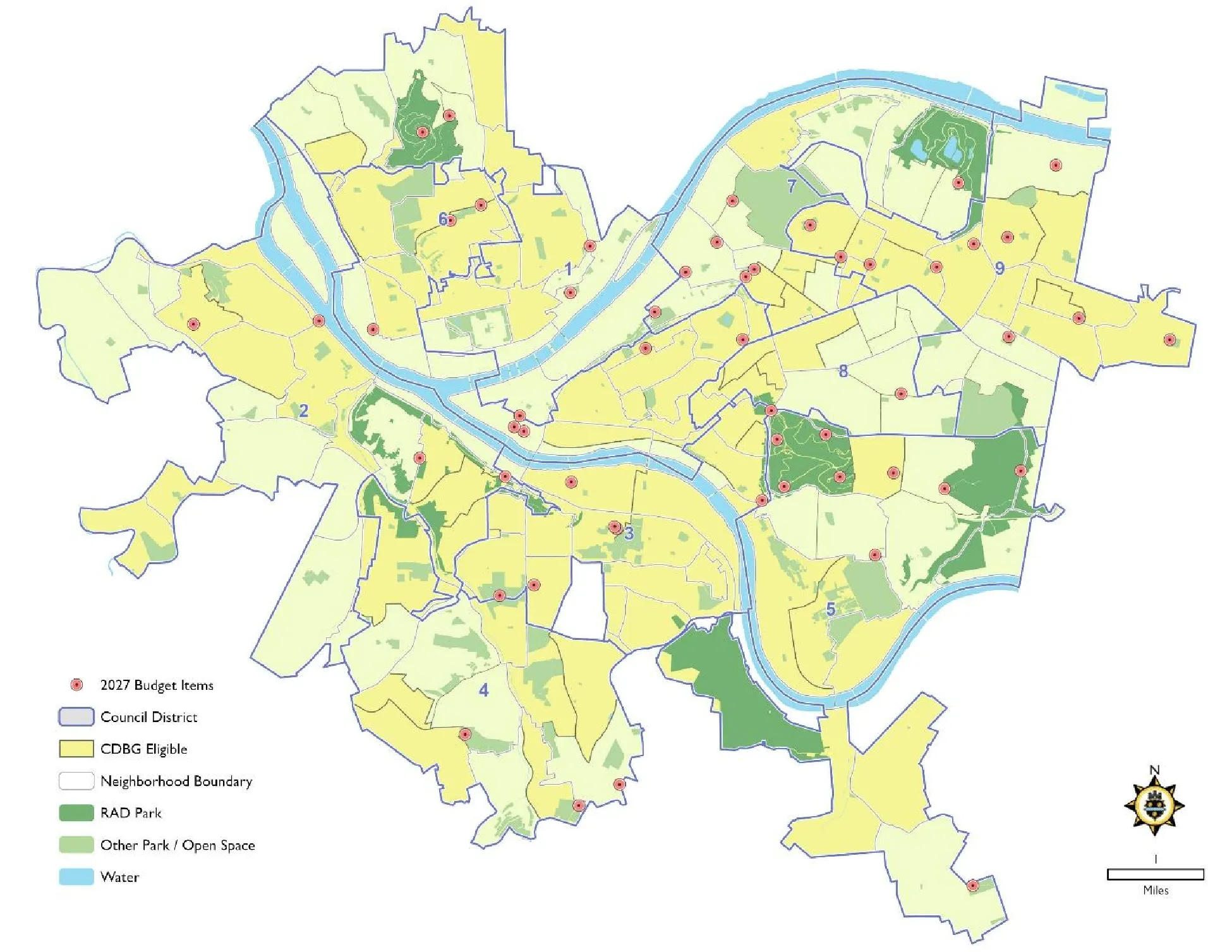
- 2027 Deliverables - a list of tentative improvements to be made using the project funds, the location, and the approximate share of the total project cost. The goal of this section is to begin the process of formally prioritizing capital needs in the City, while understanding and appreciating the need for flexibility throughout the year. The outcomes and deliverables are tentative and may change throughout the year as new needs, priorities, and emergencies arise.
- Location- a map showing the locations of the deliverables within the City of Pittsburgh. PROJECT TYPES The 2027 Capital Improvement Plan also identifies “project types” for each project, using the following definitions:
- Capital Project - Any project funded by public monies to design, build, restore, retain, or purchase any City-owned asset that is expected to provide a long-term public benefit or propose physical improvements in an element of the City’s infrastructure. Capital Projects shall have a minimum value of fifty thousand dollars ($50,000) and a minimum useful life of five years. Capital Projects financed through debt should have a minimum useful life no shorter than the length of debt service.
- Special Revenue Project - A project funded by public monies granted to the City by an outside funding source, including grants and the Community Development Block Grant. Special Revenue Projects must adhere to the rules and regulations regarding the use of funds promulgated by the funding source.
- Intergovernmental Project - A project that supports the mission of an authority or government entity through the allocation of City funding or special revenues. Intergovernmental Projects must be consistent both with the rules and regulations of the funding source, and the policies of the authority, or government entity with whom the project is undertaken. ACCOUNTABLE CAPITAL BUDGETING This Capital Improvement Plan maintains a commitment to openness and transparency in the budgeting process. By providing information such as a project justification, the Operating Budget impact, and moving toward zero-based budgeting, we are moving toward better strategic planning and assessing the true cost of capital projects. As much as possible, this CIP aims to continue on the path to accountable capital budgeting, modeled on some of the best practices in capital budgeting nationally.
2027 Project Summary
2027 Project Summary
Summarizes capital spending across projects or functional areas.
| Project Name Functional Area: Engineering and Construction | 2027 Total |
|---|---|
| 2728TH STREET BRIDGE (TIP) | 3,600,000 |
| 29BEAVER AVENUE TWO-WAY CONVERSION (TIP) | 675,000 |
| 31BLOOMFIELD BRIDGE (TIP) | 800,000 |
| 33BRIDGE PRESERVATION AND RESTORATION FUND (TIP) | 1,684,343 |
| 35BRIDGE UPGRADES | 3,250,000 |
| 37CALERA STREET BRIDGE (TIP) | - |
| 39CALIFORNIA AVENUE BRIDGE (TIP) | - |
| 41COMPLETE STREETS | 5,055,185 |
| 43CORLEY STREET BRIDGE (TIP) | - |
| 45CORLISS STREET TUNNEL (TIP) | 356,250 |
| 47DESIGN, CONSTRUCTION, AND INSPECTION SERVICES | 100,000 |
| 49EAST SYCAMORE STREET BRIDGE (TIP) | - |
| 51ELIZABETH STREET BRIDGE (TIP) | - |
| 53FLEX BEAM GUIDERAILS AND FENCING | 100,000 |
| 55FLOOD CONTROL PROJECTS | 1,165,000 |
| 57HERRON AVENUE BRIDGE (TIP) | 277,500 |
| 59LARIMER BRIDGE (TIP) | 900,000 |
| 61LIBERTY AVENUE (HSIP) | - |
| 63MAPLE AVENUE BRIDGE (TIP) | 4,000,000 |
| 65MISSION STREET BRIDGE EAST (TIP) | - |
| 67MISSION STREET BRIDGE WEST (TIP) | - |
| 69MURRAY AVENUE (HSIP) | 544,500 |
| 71P.J. MCARDLE ROADWAY (TIP) | - |
| 73P.J. MCARDLE ROADWAY BRIDGE OVER HILLSIDE (TIP) | 500,000 |
| 75P.J. MCARDLE ROADWAY BRIDGE OVER SYCAMORE (TIP) | 500,000 |
| 77PENN AVENUE RECONSTRUCTION, PHASE II (TIP) | 2,448,758 |
| 79PENN AVENUE SIGNAL IMPROVEMENTS (TIP) | - |
| 81RAMP AND PUBLIC SIDEWALK | 1,250,000 |
| 83SLOPE FAILURE REMEDIATION | 6,440,000 |
| 85SMITHFIELD STREET RECONSTRUCTION, PHASE II (TIP) | 900,000 |
| 87SOUTH NEGLEY AVENUE BRIDGE (TIP) | - |
| 89STEP REPAIR AND REPLACEMENT | 8,585,000 |
| 91STREET RESURFACING | 23,813,714 |
| 93SWINDELL BRIDGE (TIP) | - |
| 95TRAIL DEVELOPMENT | - |
| 97WEST CARSON STREET BRIDGE (TIP) | - |
| 99SMITHFIELD STREET (TIP) | 852,000 |
| 101SWINBURNE BRIDGE (TIP) | 8,281,251 |
| Total: Engineering and Construction | 76,078,501 |
Summarizes capital spending across projects or functional areas.
| Functional Area: Facility Improvement | |
|---|---|
| 105BOB O'CONNOR GOLF COURSE | 44,000 |
| 107FACILITY IMPROVEMENTS - CITY FACILITIES | 8,191,296 |
| 109FACILITY IMPROVEMENTS - PUBLIC SAFETY FACILITIES | - |
| 111FACILITY IMPROVEMENTS - RECREATION AND SENIOR CENTERS | 9,600,000 |
| 113FACILITY IMPROVEMENTS - SPORT FACILITIES | 650,000 |
| 115PARK RECONSTRUCTION | 7,500,000 |
| 117PARK RECONSTRUCTION - REGIONAL ASSET DISTRICT PARKS | 2,400,000 |
| 119PLAY AREA IMPROVEMENTS | 825,000 |
| 121PUBLIC SAFETY TRAINING FACILITY | 1,500,000 |
| Total: Facility Improvement | 30,710,296 |
2027 Project Summary Functional Area: Neighborhood and Community Development
Summarizes capital spending across projects or functional areas.
| 125BEDFORD DWELLINGS CHOICE NEIGHBORHOOD | 5,112,500 |
|---|---|
| 127HOME INVESTMENT PARTNERSHIPS PROGRAM | 1,900,000 |
| 129HOUSING DEVELOPMENT | |
| 131MAJOR DEVELOPMENTS | 1,000,000 |
| 133WAR MEMORIALS AND PUBLIC ART | 100,000 |
| Total: Neighborhood and Community Development | 8,112,500 |
Summarizes capital spending across projects or functional areas.
| Functional Area: Public Safety | |
|---|---|
| 137REMEDIATION OF CONDEMNED BUILDINGS | 3,224,195 |
| Total: Public Safety | 3,224,195 |
Summarizes capital spending across projects or functional areas.
| Functional Area: Vehicles and Equipment | |
|---|---|
| 141CAPITAL EQUIPMENT ACQUISITION | 20,379,305 |
| Total: Vehicles and Equipment | 20,379,305 |
Summarizes capital spending across projects or functional areas.
| Functional Area: Administration/Sub-Award | |
|---|---|
| 145CDBG ADMINISTRATION | 220,000 |
| 147CDBG PERSONNEL | 1,100,000 |
| 149CITY COUNCIL'S PUBLIC SERVICE GRANTS | 650,000 |
| 151EMERGENCY SOLUTIONS GRANT | 1,100,000 |
| 153FAIR HOUSING | 30,000 |
| 155HOUSING COUNSELING | 100,000 |
| 157HOUSING OPPORTUNITIES FOR PERSONS WITH AIDS | 1,400,000 |
| 159MAYOR'S PUBLIC SERVICE GRANTS | 100,000 |
| 161NEIGHBORHOOD ECONOMIC DEVELOPMENT | 720,000 |
| 163NEIGHBORHOOD EMPLOYMENT CENTERS | 210,000 |
| 165PITTSBURGH EMPLOYMENT PROGRAM | 330,000 |
| 167SENIOR COMMUNITY PROGRAM | 800,000 |
| Total: Administration/Sub-Award | 6,760,000 |
Summarizes capital spending across projects or functional areas.
| Functional Area: Administration/Sub-Award | |
|---|---|
| Total: All Functional Areas | 145,264,797 |
2027 Project Deliverable Locations
2027-2032 Capital Improvement Plan
2027-2032 Capital Improvement Plan
CDBG BOND PAYGO OTHER TOTAL
Summarizes capital spending across projects or functional areas.
| 2026 | $12,913,351 | $51,002,000 | $21,169,648 | $27,822,441 | $112,907,440 |
|---|---|---|---|---|---|
| 2027 | 12,500,000 | 66,500,000 | 8,700,000 | 57,564,797 | 145,264,797 |
| 2028 | 12,500,000 | 68,500,000 | 6,150,000 | 81,605,561 | 168,755,561 |
| 2029 | 12,500,000 | 60,500,000 | 5,400,000 | 58,169,214 | 136,569,214 |
| 2030 | 12,500,000 | 60,500,000 | 5,400,000 | 44,395,150 | 122,795,150 |
| 2031 | 12,500,000 | 60,500,000 | 5,300,000 | 63,325,000 | 141,625,000 |
| 2032 | 12,500,000 | 60,500,000 | 5,300,000 | 8,900,000 | 87,200,000 |
| Total 2027-2032 | 75,000,000 | 377,000,000 | 36,250,000 | 313,959,721 | 802,209,722 |
Engineering and Construction